|
|
2026 Olympiad Report
Welsh Chess Players Shine on International Stage – Narrowly Miss Out on Olympiad Medal
Report by FM Jonathan Blackburn
Welsh chess enjoyed one of its most encouraging international performances in recent years as our players represented Wales with distinction at the 46th FIDE Chess Olympiad in Samarkand, Uzbekistan.
The Olympiad is the biggest team event in international Chess, bringing together around 200 national teams and many of the strongest players in the World. The 2026 event was held in Samarkand, with the main competition running from 16–27 September. Teams competed over 11 rounds using the Swiss system, with four players representing each country in every match and a fifth player available as a reserve.
Wales entered teams in both the Open and Women’s competitions, and there was plenty to celebrate.
Open Team Exceeds Expectations
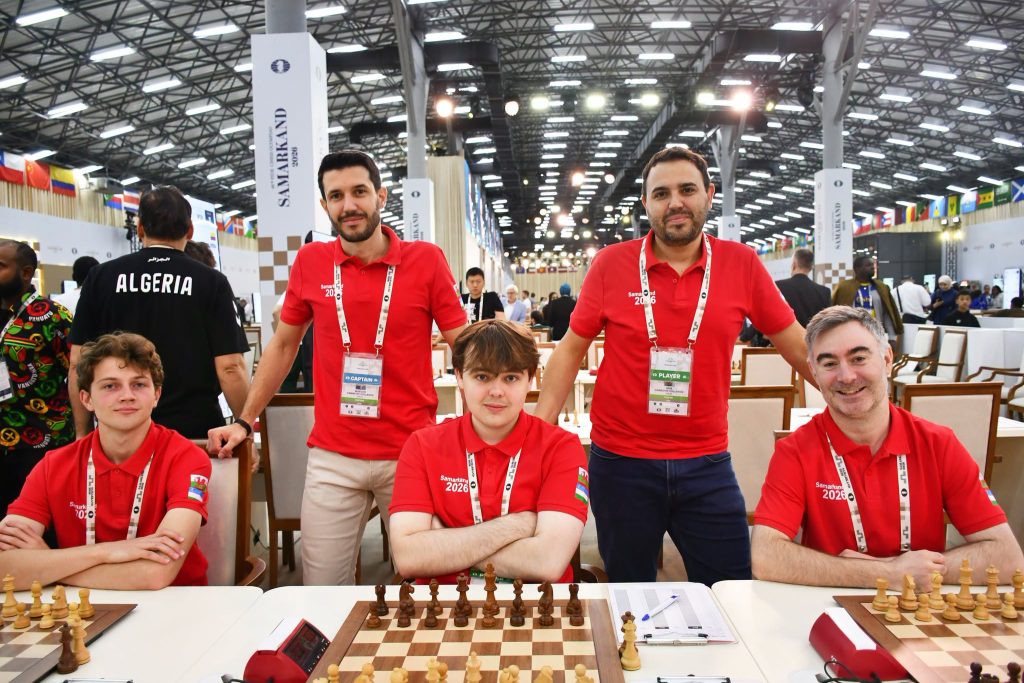
The Welsh Open team consisted of IM Jose Camacho Collados, FM Jonathan Blackburn, CM Ifan Rathbone-Jones, Iwan Cave and CM Alex Bullen, captained by IM Marcos Camacho Collados.
Over 11 rounds the team recorded six match victories and five defeats, eventually finishing an excellent 73rd overall – 27 places above their starting seeding of 100th.
There was also individual success to celebrate. Olympiad debutants Iwan Cave and Ifan Rathbone-Jones both produced outstanding performances that qualified them for the FIDE Master title. Ifan finished with 6½ points from nine games and a 2206 performance rating, while Iwan scored six points from nine games.
Supporters at home were also able to follow the team throughout the event. Jonathan Blackburn produced regular YouTube round recaps for the Welsh Chess Chat channel, while Luke Honey provided live streaming and commentary on the rjchess Twitch channel – Ifan Rathbone-Jones’s channel. This helped bring the Olympiad experience back home and allowed Welsh chess supporters to follow the team’s progress throughout the competition.
Success for the Women’s Team
The Women’s team also had plenty to celebrate.
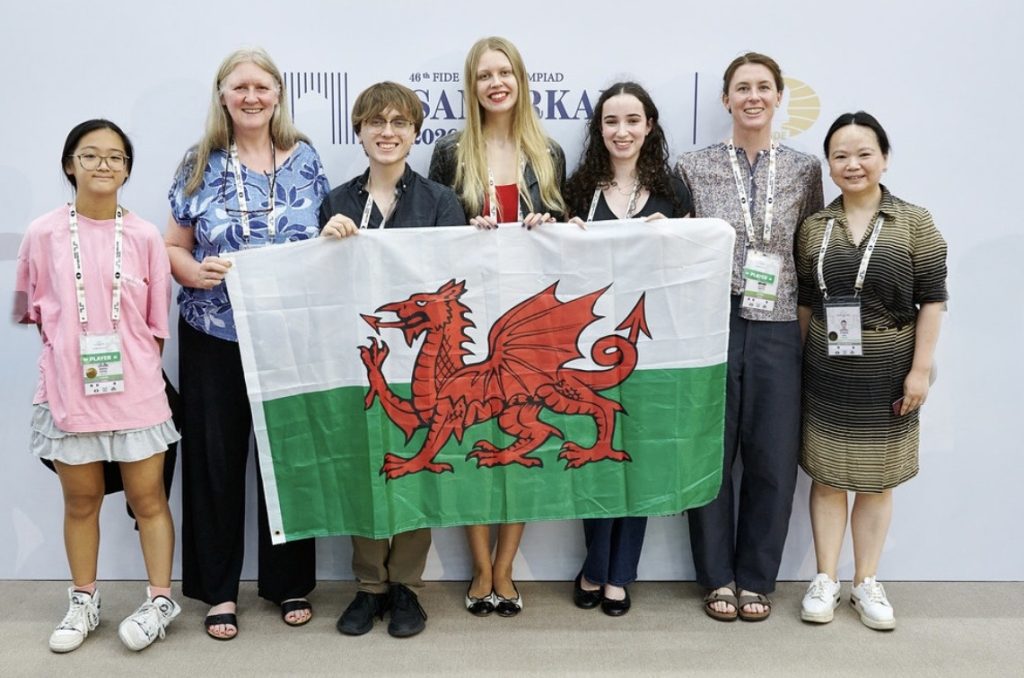
Wales were represented by WFM Olivia Smith, WCM Imogen Camp, current British Under-16 Girls Champion Emma Kong, Susanna Fraser and Syringa Camp, captained by Daniel Gallagher.
The team finished the competition with five victories, one draw and five defeats, scoring 11 match points.
There was further title success, with Susanna Fraser and Syringa Camp qualifying for the Woman Candidate Master title, meaning four Welsh players returned from Samarkand having achieved new international titles.
Going into the final round, the Welsh women were sitting an impressive seventh in their Olympiad category, putting them within sight of an exceptional category finish. Although the final round did not go Wales’s way, their campaign demonstrated once again that Welsh players can compete successfully on the international stage.
Agonisingly Close to an Olympiad Medal
For the Open team, the final two rounds produced a dramatic conclusion to an already successful Olympiad.
In Round 10 Wales faced a higher-rated Costa Rican team. On paper Wales were the underdogs, but the players produced one of their performances of the tournament to record an outstanding 3–1 victory.
The result propelled Wales into first place in their Olympiad category with just one round remaining.
The reward? An even tougher final-round pairing against Chile.
Wales needed another big performance – and there was early hope.
FM Jonathan Blackburn gave Wales the lead with a superb victory over 2422-rated IM Mauricio Emmanuel Marrujo Pardo, a player almost 200 rating points higher. Suddenly, an Olympiad category medal was very much within reach. The remaining games provided a tense finish. Chile fought back on the lower boards, but on Board one IM Jose Camacho Collados was involved in one of the longest games of the round against 2450-rated GM Pablo Salinas Herrera.
With the other games completed, Welsh players and supporters were left on the edge of their seats as Jose battled on. He eventually secured the draw, completing a narrow 2½–1½ defeat for Wales.
Such was the complexity of the Olympiad tiebreak system that even losing the match might still have been enough to secure a category medal. Only when the final games around the hall had finished and the calculations came in did Wales discover their fate.
Fourth place in Category C.
Wales had come agonisingly close to an Olympiad medal, ultimately missing out by just a single tiebreak point.
There was understandable disappointment after getting so close, but it should not overshadow what the team achieved.
Wales had entered the Olympiad seeded 100th and finished 73rd overall – an improvement of 27 places. The team finished above Celtic rivals Scotland and level with Ireland on match points, a significant achievement for a small chess nation competing on the biggest international stage.
What Could Wales Achieve with Greater Support?
The results are particularly significant when the resources available to Welsh players are compared with those of many other nations.
International chess is becoming increasingly professional. Federations around the world invest in coaching, preparation, travel and player support to give their national teams the best possible chance of success.
Closer to home, Scotland raised thousands of pounds to support its Olympiad teams through a combination of federation funding, private sponsorship and crowdfunding.
Despite comparatively limited resources, Wales demonstrated over 11 rounds that our players belong on this stage.
That raises an exciting question: What could Welsh Chess achieve with greater financial and commercial backing?
Four new international titles. Two competitive national teams. A 27-place improvement on seeding for the Open team. And an Olympiad category medal missed by a single tiebreak point.
There is plenty for Welsh Chess to celebrate.
These players should be recognised as Welsh sporting representatives competing for their country on the international stage.
More importantly, the performances in Samarkand demonstrate the potential that exists within Welsh chess. There is a growing generation of talented players, coaches.
The challenge now is to build upon that success.
The Welsh Chess Union is keen to develop sponsorship and partnership opportunities with organisations that want to support our international teams, talented young players and the wider development of Chess throughout Wales.
We should celebrate the players who represented Wales in Samarkand and the achievements they brought home.
The future of Welsh chess is bright – and with greater support, this could be just the beginning. Should you be interested in sponsoring our fantastic players or partnering WCU, please contact Vicky Hammett- publicitydirector@welshchessunion.uk.
 Screenshot
|
|
