
Gwynedd covers the former counties of Anglesey, Caernarvon and Merioneth. It will come as no surprise that the area failed to create a chess league before the 1970s. Sited away from the industrial centres, early chess clubs were few and far between and rarely lasted more than
a couple of years.
CHESS BEFORE THE GREAT WAR
Organised chess was late arriving in the north west of the Principality. Whilst chess flourished in South Wales and the North East, apart from games being available in libraries and institutes, there was precious little effort made to encourage competitive games in Caernarvonshire and Merionethshire. The Reading Club at Dolgellau for example, announced in 1876 that a chess table and chess men had been presented and, two years later, a room was taken for a Social Club in the town hall at Holyhead which included chess boards amongst other games paraphernalia.
Was there ever an actual club at Dolgellau? Probably not, though in 1906 Edward Petit Jelf-Reveley of the Bryngwin estate, Dolgellau was noted as President of the Barmouth club and in 1912 Evan Wynne Williams, a Dolgellau vet, played on top board for Barmouth.
There were obviously players living in the area. ‘B. Croft’ from the town was corresponding regularly with the editor of the chess column in the Cambrian newspaper in 1893. And ‘Hereward’ of Dolgellau was solving problems in the Illustrated London News ten years later. But where were the clubs?
BANGOR 1884-1915
A meeting-room for chess players was set aside at the Queen’s Head café in High Street, Bangor in January 1884. H. T. Roberts was the man in charge. (This could be Hugh Thomas Roberts who was charged with embezzlement a few years later and that may be the reason the club did not survive.) The club closed at the end of April and re-opened in November but by the following April the newspaper reported that the club had collapsed.
In December 1895 the club was re-formed under the Presidency of Dr. Emyr O. Price, meeting at the Eagle Cafe. Their stated aim was ‘to afford shop assistants and others an opportunity of becoming acquainted with one of the most fascinating of games.’ Membership was restricted to 25 due to lack of space. The first flush of enthusiasm saw games being played every night at the café and there was talk of ‘well-known chess players of the city’ becoming honorary members.
The following February the first of many local derbies was fought out with neighbouring Caernarvon. The Bangor players were regarded as novices compared to their Caernarvon opponents and deemed to have no chance of winning the match. The Caernarvon champion, Colonel C. A. Rees for example was pitted against a man who had only just learnt the rules of the game. Caernarvon won 19-5. Eight boards were played and on each three games were played. T. J. Williams was the top player for Bangor.
Another fixture for the club was against Menai Bridge. The first mention of such matches was in the 1898-9 season when Bangor won the first encounter 13-9 (7 players each) and the return 12.5-8.5 with J. C. Jones and Dr. Emyr Price leading the team. The Menai Bridge club met at the Institute and was still in being in November 1910 when J. E. Parry of Bangor visited and gave a simultaneous display, losing one of his seven games.
There were still matches being played with Caernarvon in March 1906 when the Bangor team, led by Price White and F. Gascoyne won convincingly, 5-2. The teams were shown as representing the Y.M.C.A. in each town.
A North Wales Chess Association was formed on 16th December 1908. Bangor was the only Gwynedd club represented along with eight other clubs, the nearest being Llandudno and the furthest Mold. A week later a match was played between the Coastal Towns of North Wales and the Inland Towns. The Coast was led by J. E. Parry who was a native of Bangor.
Bangor entered the new North Wales Chambers Challenge Cup which was split into western and eastern sections to ease travel difficulties. They beat Colwyn Bay in the first round and in the final of the western group, they beat Abergele 4-3. J. E. Parry and Dr. E. O. Price loston the top boards. Abergele, as a new club, was lauded by the British Chess Magazine, playing seven matches in all, being unbeaten until the semi-final already mentioned and even having a chess column in the Abergele Times, but the club did not last long.
The match against the winners of the Eastern section, Ruabon, was played in Chester in June. The Bangor eight were led by J. E. Parry, Dr. E. O. Price, Price F. White and T. Muir. Parry and Muir both won but the others all lost.
The two mainstays of the club were honoured by the new N.W.C.A., Dr. Price being made a Vice-President and John Parry being elected vice-captain and being elevated the following year to captain). Judge Bryn Roberts of Bangor was also made a vice-president.
The nature of some of these encounters may be illustrated by a report on a match in spring 1910 when the Bangor team travelled to Colwyn Bay. “The visitors arrived at about 4 p.m. and, after a stroll in the woods, and a substantial tea as the guests of the local club at the Café Royal, faced the boards shortly after 6 p.m.”
Ruabon, the winners of the competition in 1909 and 1910, and Bangor, met again in the 1911 Cup final played in Chester:
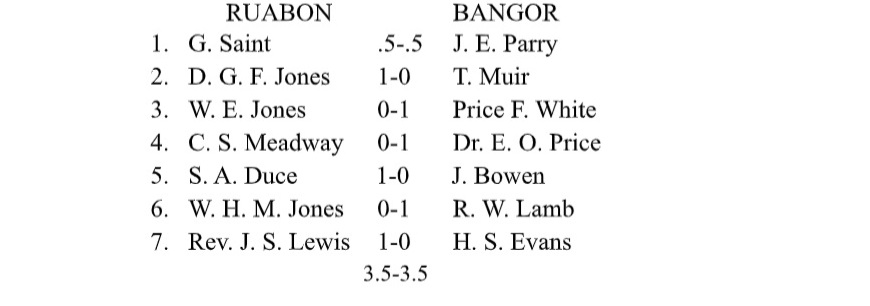
At the NWCA AGM in October, Dr. Price was elected president and it was noted that the Abergele and Llandudno clubs had folded.
The club again got to the final in 1913 but lost to Wrexham 1.5-4.5. The 1914 final was a repeat. Bangor won but the score is not known.
Parry, White, Dr. Price, F. H. Matthews and R. Jones Roberts were all representatives of the club in what was becoming an annual match between North Wales and Cheshire.
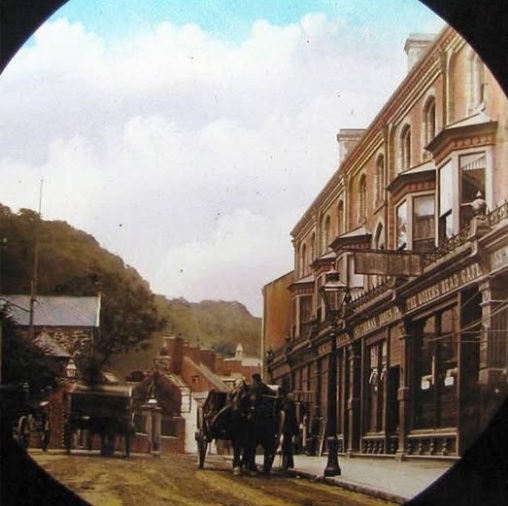
The Queen’s Hotel Cafe, High Street, is on the right
JOHN ELLIS PARRY (c1857 – 1934)
John Ellis Parry was born on a farm at Llanllechid, near Bethesda in Caernarvonshire in 1858 and moved about quite a bit with his work as a commercial traveller (tea). Apart from Captain Evans, he appears to have been the only Welsh born chess player from the Victorian era to attain strength of play which could bare comparison with their English counterparts.
Parry certainly represented a different kind of player – the working man – not coming from the elite middle class of clergy, solicitors, colliery owners etc… who made up the majority of membership for most Victorian clubs.
There is no evidence of his playing chess before 1884 and from that time onwards he represented Liverpool North End chess club, playing on a high board, (Note, this is not the great Liverpool club where Amos Burn held sway.) and Lancashire until 1900.
His name appears in the inaugural Lancashire-Yorkshire County match, playing for Lancashire, in 1898. By the end of that year, he had moved to Shrewsbury where he won the Shrewsbury Club Championship in 1899, 1901 and 1904 and played top board for the county team.
In 1899 he won the Shropshire County championship. He may well have won it on other occasions but records have not survived.
At the time of the 1901 census the Parry family were living in Shrewsbury; however, he appears to have been looking for a change of employment as in March the Carmarthen Journal carried the response to an advertisement for a Master and Matron at the Workhouse.
Amongst those applying were John Ellis Parry and wife, Shrewsbury. Parry’s wife was from Cylycwm in Carmarthenshire. In May 1901 Parry played on top board for Shropshire in a match against Denbighshire. He won his game against George Saint. The Border Counties Advertizer reported “We believe this is the first occasion on which gallant little Wales has ever beaten England in a county match.” Denbigh won 6 games to 4.
On Wednesday 8th July 1903 he visited Denbigh Chess Club whilst on business in the area, and gave a simultaneous display against 15 club members, winning all the games. In the report in the North Wales Times, he was described as “of Liverpool Chess Club”, though he lived in Shrewsbury at the time and was never shown as a member of the Liverpool club.
He made the first of many appearances at the annual BCF Congress in 1905 (the 1st congress was held in 1904) at Southport when he played in the 1st Class A tournament. (He was noted as of Liverpool.) He played twice in the 12-player British Championships – in 1906 at Shrewsbury and in 1914 at Chester without much success, finishing 11th both times.
However, he did manage a draw with Joseph Blackburne at Shrewsbury. He was a member of the organising committee when the event was held in his home town.
His meanderings saw him play in other sections of the BCF tournament, at Scarborough 1909, Oxford 1910, Glasgow 1911 and Stratford 1925. At Oxford he shared a brilliancy prize – ‘The Bishop of Trinidad’s £2 2s prize has been divided between Messrs F. S. Smith, W. H. Gunston and J. E. Parry, for games against Messrs Brown, Shories, and Funk. ‘
In 1899 Parry played in the popular Craigside Hydro tournament at Llandudno which that year was won by Amos Burn. Parry played in the Second-Class section, finishing in 2nd place.
The following year he played in the Southern Counties CU Congress in Bath, finishing 9th out of 15.
Around 1907-1908 “J. E. Parry” moved from Shrewsbury back to Bangor. He played for Shrewsbury against Dawley as late as November 1907.When a new North Wales Chess Association was created in 1908 Parry was appointed Match Captain, a position he held until at least 1913. In May 1908 he was playing on top board for North Wales against Cheshire.
On the 1911 census the family was living at 4 Glandwr Terrace, Bangor, where Parry was still a commercial traveller in tea as well as being an agent for sundry grocery goods. In 1914 he was recorded as resident at Market Drayton, Shropshire. Chess records show that at some time from 1914 to 1921 he moved to Manchester.
A North Wales Individual Championship was held for the first time, under the auspices of the N.W.C.A., during 1926-7. The B.C.M. reported the winner as ‘Bellington’ and added “The old champion, J. E. Parry, did not compete”, suggesting that there were earlier North Wales Championships, but no record has yet been found to prove this.
A letter from J. E. Parry published in the British Chess Magazine in April 1933 tells us a bit about his initiation into chess circles:
“… I first knew of it (Simpson’s Divan) 50 years ago, when I resided in London, and first learned the moves of chess there. A few years after I used to be a provincial visitor at Simpson’s, and played any chess professional who happened to be disengaged. The first to challenge me was Mr. Rolland, who generously offered to play me at the odds of a Knight, but Mr. Bird told him he should not offer such odds, as I might be able to beat him without any odds! Eventually he gave Pawn, and I beat him 2 games! Next time I called, Bird and Burn were engaged in a keen game, and this took my attention for the evening. This took place the year Burn won 1st prize in the Masters Tournament on the continent and the present Dr. Lasker was second…….I afterwards played many of the players mentioned….. such as Mortimer, Jasnagrodsky, Van Vliet….. Of course, I knew Blackburne well, and was interested in him as a brilliant player and because of his mother being Welsh (a Miss Edwards before she married his father at Manchester). I doubt if anybody but myself knows this, and I had this information from his father….
Other players ….. I knew were Bryn Roberts M.P. and afterwards a Judge, hardly up to the class of a professional; Herbert Jacobs, J.H.Blake, Edwyn Anthony, whom I beat on top board in a match at Hereford; W.J.Ingoldsby, my opponent in the great match North v. South at Portland Rooms. The result was a draw. Dr. Fenton is mentioned, but I knew him as a professional and played him a few games and won all.” (Dr. Fenton is not the same person as R.F.Fenton mentioned in the chapter on S.W.C.A .)
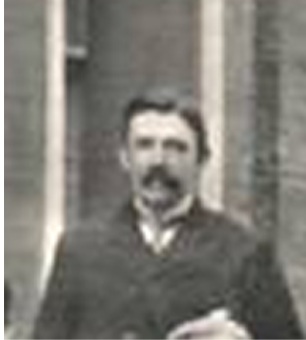
John Ellis Parry
CAERNARVON 1891-1906
The Workingmens’ Conservative Association in Caernarvon had ‘billiards and bagatelle tables, chess and draft boards etc…’ as early as 1877 but a chess club was not started until September 1891. Hugh E. Jones sent a letter to the press announcing that the club was based in the Conservative Club and had been established at the start of the year.
Nothing more is heard until autumn of 1894 and it looks like that first club quickly failed. The inaugural meeting in 1894 was held at the café on Castle Square and was instigated at the prompting of J. Bryn Roberts, a solicitor from Bryn Adda, Bangor. Some of those present were C. H. Rees, W. Bowen Jones (appointed treasurer) and S.W. Jones. Samuel Jones, J. Herbert Rees and Griffith Jones solicitor were added to the committee. A local business supplied the chess equipment free of charge. The lord-lieutenant of the county Mr. J. E. Greaves was enrolled as President, presenting a cheque in lieu of the honour, and Cuthbert Carter was appointed Hon. Secretary. J. Bryn Roberts M.P. was made one of the vice- presidents.
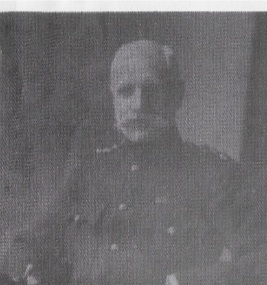
Lt. Col. Charles Herbert Rees, (1848 – 1930), with other solicitors,
he started a chess club in Caernarfon in 1894
The four best players in the club were named as Bryn Roberts, Colonel Charles H. Rees, (his son Lionel was awarded a Victoria Cross) who at this time was a solicitor in the town, Mr. Fearnen of North Rd and Mr. J. T. Pugh of Bronhendre.
In January 1895, the club’s first match was played against Merioneth at the Castle Hotel, Harlech, the hosts winning 15-5. There was no club in Harlech and the team opposing Caernarvon was a gathering of people with chess experience.
Several games were played on each board and the individual results were:
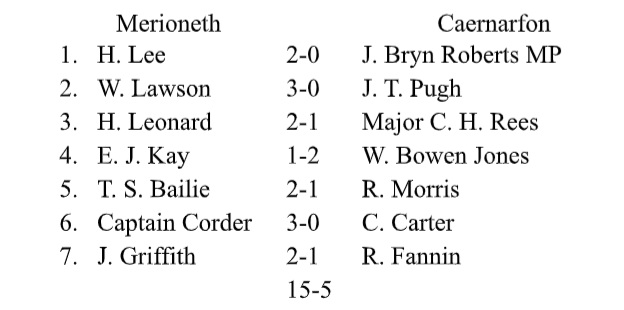
Harry Lee of Cheltenham played as a guest on top board for Merioneth and defeated Mr. Roberts. Harry Lee was probably the same person who played in the Christmas Craigside (Llandudno) tournament where he came 4th of the 7 competitors. He is mentioned in the press as the champion of Cheltenham in 1894 but died the following year at the age of 42.
Thomas Seymour Bailie was living locally but was born in Ireland and had been playing for Ireland against the West of England, and for the North against the South of Ireland. His son, John Seymour Bailie, later played chess at Bangor University. Mr Leonard was the only Harlech man in the Merionethshire team. Of the members of the Carnarvon team. Bryn Roberts. M.P., was considered one of the best chess players in the House of Commons.
By the end of the 1894-5 season, the club had 40 members.
There was intense rivalry between the clubs at Bangor and Caernarvon and the first match between them seems to have been played in January 1896 when Caernarvon were victorious 19-5. On top board Colonel Rees lost to Dr. E. O. Price. It was customary to play several games on each board but the doctor was called away before a second game could be commenced. Bowen Jones actually played three games and won them all, the newspaper reporting, that he ‘being a far older player had a great advantage from the start’.
In October 1896 the much-travelled John Chambers, the former Scottish champion, played in the Magistrates’ Room in Caernarvon, winning 8 and losing 2. One game was drawn when a player had to leave early. Chambers blundered against Griffith Jones and lost a ‘brilliant game’ to Colonel Rees.
Caernarvon defeated their close rivals in two matches in 1896 but were finally beaten by Bangor in February 1897 at the Sportsman Hotel, Caernarvon by 16 games to 7.
From that time until April 1906 there is silence. Did the club continue? Or did it disappear entirely?
The only other pre-war mention in the press is of the Caernarvon YMCA losing two matches to Bangor YMCA in 1906 with J. L. Harris and J. W. Jones leading theCaernarvon team. The match was lost 2-4.
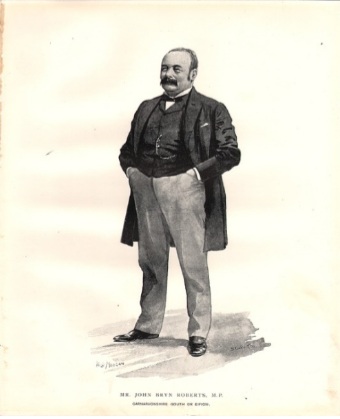
John Bryn Roberts MP
BANGOR UNIVERSITY 1900 – 1907
The Magazine of the University College of North Wales holds records of a chess club meeting in the university at Bangor from June 1900. That publication named John Seymour Bailie as club secretary. He was from Porthmadog (qv). Bailie was noted as winning a handicap tournament scoring 9/10 and the club had an attendance of up to 23 players who met in Central Café.
The following year recorded that one of the students, R. E. Davis, drew with Lasker in a simultaneous display at the Lancaster chess club. He was the only one of the 16 players not to lose and was a piece ahead when the draw was agreed.
Matches against Normal College are noted from 1903. H. Hilton M.A. was the lead player for the university. Harold Hilton (1876-1994) had represented Oxford in the Varsity matches of 1899 and 1900. He was appointed to the university in Bangor in 1902 as an assistant lecturer in mathematics. In 1907 he moved to Bedford College, London.
By 1904 they were also playing matches with the Bangor town club and by correspondence with the students and staff of the university in Aberystwyth. The top board result in that match resulted in two wins for Hilton over Professor Genese.
A club championship was held in 1905 and won by the club secretary, F. N. Gasquoine with 8/9, the runner-up being P. G. Thomas on 7. 5. Dr. E. O. Price from the town club played and lost to both the university top players. Francis Noel Gasquoine (1885-1927) was the son of a clergyman. 1905 was said to be a quiet season as they couldn’t find any opponents.
A year later victories over Bangor YMCA 5-3 and Colwyn Bay 5-2 showed that the university could be a match for anyone but the loss of Professor Hilton only highlighted the club’s difficulties getting teams together and the club appears to have ceased competition at this time.
ABERDOVEY 1901 – 1907
There is a very brief mention of an early club at Aberdovey, with reference to an event in February 1901 when they entertained John D. Chambers, the wandering chess promoter who was so often linked to Welsh clubs. The display took place at the Literary Institute which had previously been a bath house and a home to the Plymouth Brethren.
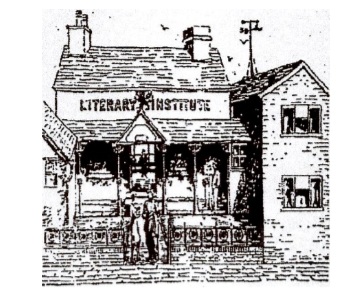
Aberdovey Literary Institute
Mr Chambers played eleven games simultaneously against Messrs J. M. Jones, Owen Jones, W Jones (R.O), C. L. Burgess, Thomas Walter Evans, Robert Richards, Richard Williams, William Eves, D. Lewis Davies, Edwin Hughes, and Ffestin Williams, and won every game.
The display took four hours to complete, which seems a very long time for such a small number of games though afterwards Chambers paid them the compliment that he was surprised to meet so many good players.
This was a chess club rather than an ad hoc gathering as the report mentioned that W. Jones was club chairman and Ffestin Williams the treasurer.
The next mention of chess activity in Aberdovey was in February 1907 when the members of the Barmouth Reading Room played a match with members of Aberdovey Literary Institute.
PORTHMADOG 1904 – 1905
Porthmadog is perhaps typical of many of the chess ‘clubs’ in this area. Rather than a club as such, it was more a team put together to play the odd friendly match. Thomas Seymour Bailie from the town, has already been mentioned, playing in 1893 for Merioneth against Caernarvon.
In December 1904 the Liberal Club at Porthmadog hosted a match between the town and the village of Minffordd, about five miles away, winning by 4 games to 3. The team was led by Rev. William John Nicholson, an independent minister in the town.
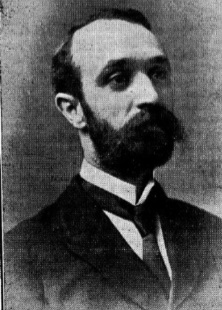
Rev. Nicholson (1866 – 1943)
BARMOUTH (1905 – 1919)
There were never many chess clubs in Merionethshire. Clubs at Barmouth, Aberdovey, Bala and Towyn were all short-lived.
County School. Taliesin Morgan was born in Cwmavon near Port Talbot in 1882. After obtaining his degree in London he was appointed in 1904 as a Science Master at Barmouth County School. He left the area in September 1906 to take up a teaching post in Ebbw Vale.
The new club appointed Jelf Reveley JP from Dolgellau as the President and J. Ansell of Cors-y-gedol Hall vice-president. Charles W. Hughes acted as secretary. Neighbouring clubs were few and far between and a challenge to Porthmadog, 20 miles away, was declined. One of the first club championships was won in December 1906 by C. W. Hughes of the all-Railways Company, Taliesin Morgan being runner-up. Charles William Hughes was a railway clerk. He was born in Whittington, Shropshire and moved to the Barmouth area around 1900. At about this time he was appointed club secretary. Early in 1914 he was promoted to station-master at Overton-on-Dee, a few miles from Wrexham. The club president had already changed and J. Snell was appointed, the chairman being G. E. Owen.
A report in the Barmouth Weekly News in February 1907 stated that ‘keen and interesting tournaments have periodically been arranged’. Club activities included a handicap tournament with a first prize of eight shillings.
The club next aimed at matches against a club at Aberdovey, 28 miles away. The three-hour event resulted in a narrow 8-6 win for Barmouth. Their team was: C. W. Hughes, A. Sinclair, J. Thomas, J. Jones, G. E. Owen, C. H. Miers and William Owen. Two games were played on each board with Hughes winning both matches on top board. It was felt that Aberdovey were at a disadvantage because they had young players!
Things were much more civilised in the Edwardian era with the arranged match being preceded with or finished off with tea and speeches. In the return match a couple of weeks later Aberdovey won 8-5 with one game drawn.
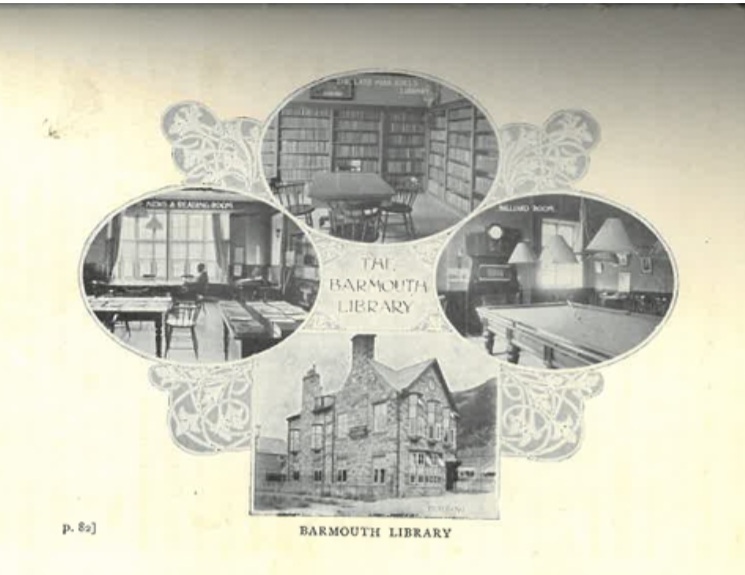
Courtesy of Barmouth Library
Later the same month a prize was awarded to C. W. Hughes for winning a chess tournament in the club. C. H. Miers J. P. won two prizes. Capel Hanbury Miers (1844-1914) had been a war correspondent for the Daily Telegraph during the Zulu war. The Miers family were well-known Neath industrialists. The enthusiastic players travelled to Penrhyndeudraeth in March to play against ‘Excise officers and others’ from Penrhyn, Porthmadog and Criccieth. Play on this occasion lasted from 1.30 p.m. to 6.45 pm though there was a half an hour break mid-way for refreshments. The home team won by two points but it was decided that the over-all score should be decided only after the return match scheduled for the following Saturday. That event was shown as four games played on each of the five boards with the result a tie 10-10.
The Barmouth team was C. W. Hughes, A. Sinclair, J. Thomas, J.Jones and G. E. Owen. redoubtable Hughes won his individual encounter 3 games to 1. At the club’s AGM in November 1907, Capel H. Miers was elected Club President. A handicap tournament was to be organised with first prize eight shillings and second prize five shillings.
The following night the library entertained John D. Chambers who was lauded as, ‘Champion Amateur Chess Player of Wales’. This might have been something of an exaggeration as he generally submitted his own newspaper articles. However, he had won the Scottish Championship in 1892 and some years later was to win the South Wales Championship. He certainly did more for the p ropagation of chess in the United Kingdom than almost any other person, travelling a lot with his job as a representative of MacLeay, Duff & Co., distillers of Glasgow, and supporting or setting up chess clubs wherever he went. He proved too strong for six Barmouth players. He commented that he had been visiting Barmouth for twenty years and did not know there was a club in the town. He was made an honorary club member.
Chambers returned in February 1908 and took on eight opponents and won them all. Very generously he presented a chess board and set for competition in a tournament at the club.
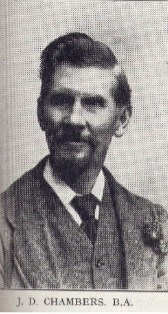
By October that year the Barmouth club was reported as having 20 members. The President by now was G. E. Owen of Greenwich House with C. W. Hughes still continuing as secretary.
When the North Wales Chess Association was formed in December 1908, no mention was made of the Barmouth club.
The club continued to meet but reports of its activities were few and far between. A tournament held in January 1910 was won by William Garnett, a 37-year-old house painter. In March 1912 it was reported that Aberdovey visited for the annual match which was played in the Barmouth library. C. W. Hughes is not mentioned and the Barmouth top board in this match was E. Wynne Williams who won one of his two games. He was a vet in Dolgellau but his brother was a chemist in Barmouth hence his chess allegiance. J. Jones was the Barmouth club secretary. That was the last report of a club in Barmouth for the rest of the century.
BETWEEN THE WARS
At the re-formation of the North Wales Chess Association in 1922, a Silver Rook was bought by the parent body for the Club Championship revival with six clubs competing; Llandudno, Rhosllanerchrugog, and Wrexham to the east and Colwyn Bay, Rydal Mount school and Bangor University to the west. The competition flourished until 1932, when the Depression was at its height and was having an effect on all chess activities in Wales. It was revived again in 1949 after a lapse of 17 years, but seems to have been confined to the coastal clubs.
Information about chess activities in the Gwynedd area is particularly scarce. Only a few clubs are mentioned in the newspapers and other records.
BALA 1933 – 34
The Rhos Herald was the source for brief mentions of a club in Bala. Three matches are mentioned; the first in February 1933 and the last in January 1935. Wrexham (1933) and Rhos were the visiting clubs.
The top board for Bala in the first match was Edward Vaughan Roberts (1899-1980). He worked for Great Western Railways and in 1926 was mentioned as winning a third-round match in the Great Western Railway Championships. In the final of the 1938 North Wales
Championship, playing for the Lord Mostyn Cup, he lost to Leslie B. Hall of Llandudno 2 games to 1 after a total of 11 hours play. The Wellington Journal also mentions him as a member of the Welsh Chess Union guesting for a team in Shropshire as late as 1964. The club’s Board 2 was an accountant at the National Provincial Bank in the town, R. Kenyon Jones.
BANGOR UNIVERSITY (1922 – 31)
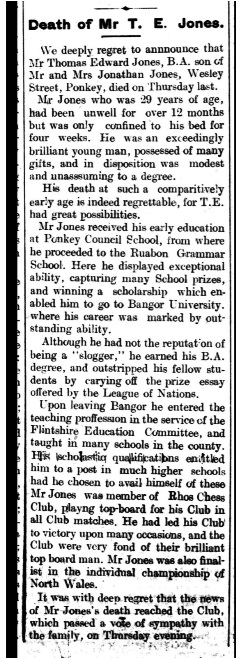
The university was the only club from the area to re-enter the North Wales team competition in 1922 and they lost heavily to Rydal Mount school in the first round. The following year they appeared stronger, defeating Llandudno 4-3 in the first round. That team was T. E. Jones, C. H. Lewis, W. H. Thomas, Gwyn Williams, C. E. Humphreys, E. Smith and O. Pritchard. Trevor E. Jones was particularly strong. He was from Rhos and was to play much chess for his home team after taking his degree. In this match he drew with T. H. Billington. Jones beat Rubenstein in a simul in 1925 and he lost to T . H. Billington in the final of the North Wales individual championships in 1927. Very sadly, just a couple of years later, the Rhos Herald ran his obituary (24h August 1929).
Bangor University won the North Wales trophy in 1931, beating Wrexham 3.5-2.5 in the final. The team scores are not known but there is no doubt that Baruch H. Wood and W.Ritson-Morry would have been key team members.
BARUCH HAROLD WOOD (1909 – 1989)
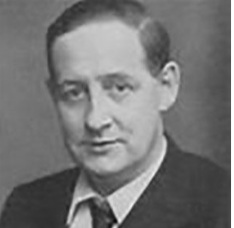
Barry Wood
Born in Sheffield, his family moved to Tregarth after the war and he became a pupil at Friar’s School, Bangor. There he met William Ritson Morry who later became an organiser of the game in the Midlands. They started a chess club in the school in about 1925, playing matches against Bangor and the university.
From Friar’s, he went to the University College of North Wales, Bangor, playing on top board and in 1929 was on Board 5 for North Wales in their match against Cheshire. In 1930 he played in a simul against Znosko-Borowsky
He left university in about May 1931, with a 1st class honours BSc degree in chemistry. In 1935 he started the magazine ‘CHESS’ from his base in Sutton Coldfield and ran it for over 50 years. Wood played a number of times in the British Championships, tying for second place in 1948 and represented England in the Buenos Aires Olympiad of 1939. He won the British Correspondence Chess Championship in 1944-5.
BANGOR
The Bangor YMCA club was hard-hit by the death of the club president, Dr. Emyr Price in February 1919. Dr. Price came to Bangor after obtaining his medical degree at Edinburgh. He was very much involved in the daily life of the city as he became a member of the Bangor City Council and it was largely due to his foresight and energy that the site for the University College of North Wales was acquired by the town and presented to the college.
At the first AGM of the revived NWCA in March 1922, Bangor chess club was represented although they did not enter a team for the Silver Rook Trophy. J, Bryn Roberts was elected one of the vice-presidents of the Association. They did compete 1922-3, losing to Rydal Mount School.
‘Bangor’ continues to be mentioned in upcoming fixtures for the Challenge Cup but without any detail so it is unclear whether the references are to Bangor or Bangor University.
OTHER CLUBS
Holyhead Liberals entered the North Wales Championships in 1924 and continued to compete until the event stopped in 1932. They reached the semi-finals in 1930 when they lost 0-7 to Llandudno and in 1930 when Rhos were victorious. In the latter match, Rhos were quite prepared to travel by car to Holyhead (94 miles) but a forecast of heavy snow led to the match being played in Bangor after a train journey. This was the only time the Holyhead team were named and their top board was J. Bellis. Tal Read, the Rhos top board, mated his opponent in 15 minutes, only to discover that it wasn’t mate and he had lost a piece! Read was still strong enough to win the game easily enough.
The last mention of the Holyhead club was in 1933 when Rhos played them in a friendly match.
There was also a short-lived club in Bangor Normal College round about 1930 which played matches against the university. This was a Teacher Training College.
AFTER THE WAR
Chess activity after the war was confined mostly to the eastern part of North Wales. The North Wales Chess Association and team tournament was revived but quickly deteriorated with the 1951 title being the last awarded. There was no individual event. Some clubs closer to the English border linked up with the Chester league from 1954. A new N.W.C.A. ran from 1961 until 1966, but again there was no involvement from clubs as far away as Caernarvonshire and Anglesey.
BANGOR
The club championship of North Wales was revived during the 1949-1950 season after a December meeting in Rhyl; matches being scheduled between January and April. William H. Lane of Bangor was appointed one of the Association vice-presidents. Bangor took part that year and reached the semi-final, losing to the eventual cup winners Colwyn Bay, 1.5-4.5. The Bangor team was W. H. Lane, R. J. Evans, C. Griffiths, F. E. Clegg, T. Owen and E. Y. Lloyd Jones. Bangor held their own on the top boards but did not have the strength in depth of their opponents. There is no further mention of a Bangor club for the next few decades. The first three named all played for North Wales in the annual matches against Cheshire 1948-50.
After 1952 Bangor club disappears from the press and indeed, the only chess activity from the Caernarvon area mentioned at this time related to the club at Friar’s school. The lead player at Bangor, William H. Lane, played for the Coastal Towns against the Inland Towns in the late 40s and after the Bangor club folded he played for many years for Colwyn Bay.
CAERNARFON
In the autumn of 1959, when Mr. Dafydd Wigley (later M.P. for Caernarfon) was a pupil at Rydal Mount School in Colwyn Bay, his father, Mr. E. E. Wigley took a chess team to play against the school. This action prompted the formation of a club at Caernarvon which flourished at the Refectory in the County Offices.
For many years the new club at Caernarfon had little opposition with only the University and Rydal Mount School operating occasional teams. The club’s strongest player and first secretary was Mr. C. M. Cox who had previously been a member of Bangor Chess Club. He left the district in 1962 and Mr. R. Iorwerth succeeded him in office.
BANGOR UNIVERSITY
The newspapers have brief coverage of several matches between Colwyn Bay and the University in the 1950s and 1960s but there is no involvement in any sort of competition other than the Welsh Universities’ Championships. This was a Jamboree Tournament held each year alongside the eisteddfod with each of the four universities fielding six boards.
Bangor are recorded as finishing third in 1968 and fourth in 1969.
GWYNEDD LEAGUE
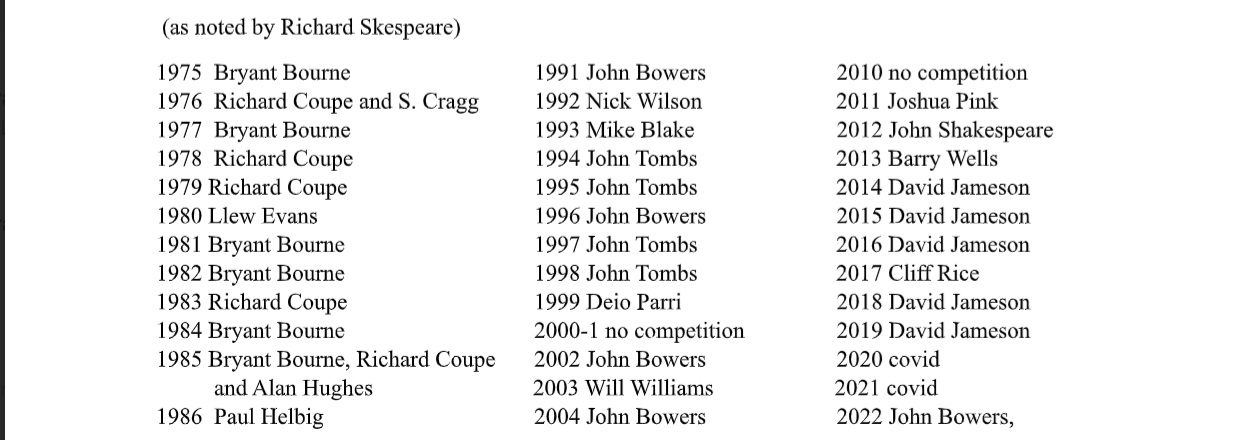
The Gwynedd chess league was created in 1973 by Emyr Williams. He was born in Bethesda and moved to London to work for the BBC. From there he transferred to Bristol where he spent the next ten years and he and his young family fell in love with the game of chess. He moved back to North Wales, again working for the BBC, this time in Bangor, and settled in the village of Tregarth. There he set up a new chess club and shortly afterwards established the Gwynedd Chess League. It has survived (just) for over fifty years, but the number of clubs participating has fluctuated from 6 or 7 to just two. Tracking down results of competitions has been extremely difficult and there are still many gaps in the list of league winners, in particular 1996 and 1998-2016.
The league started life as the Anglesey Chess League, even though Tregarth is not on the island. Ferodo (car parts factory, Caernarfon), Bernard Wardle (a factory producing PVC coated fabrics, imitation leather and synthetic materials at Caernarfon), Tregarth, Holyhead.
Alexandra (probably the Alexandra Hotel, Caernarfon) and the Caernarfon club all took part.
Clubs have come and gone – including Llanberis, Beaumaris, Bethesda, Ynys Mon and Bangor University.
TREGARTH 1973 – 1989
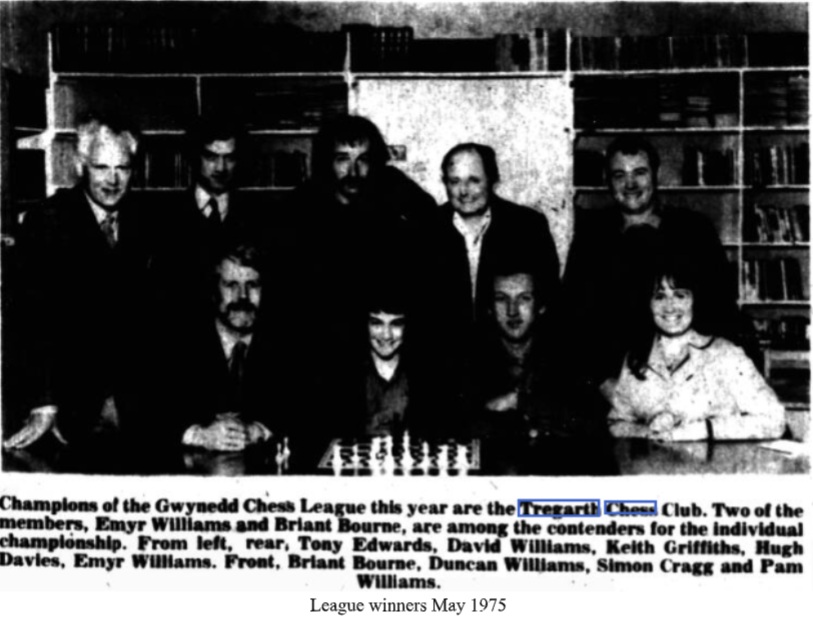
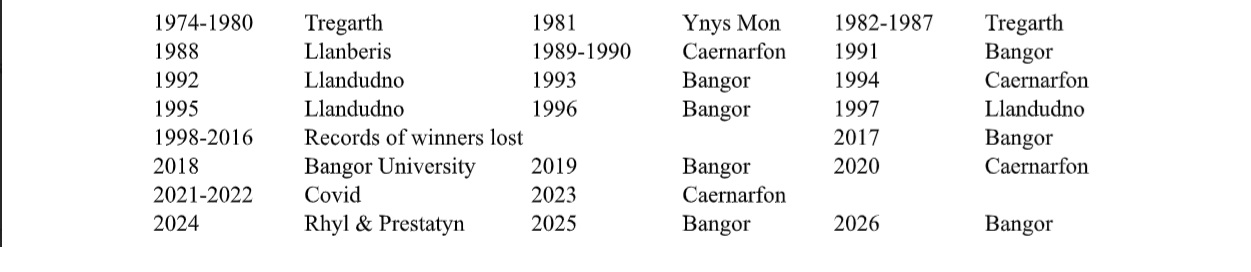
Tregarth is a small former slate village of just over one thousand people situated between Bangor and Bethesda. It is too small a community to sustain a chess club of itself, but for many years the club sited there attracted some of the better players in the Gwynedd area. The club won the league title from 1974 right through to 1987 with the sole exception of 1981.
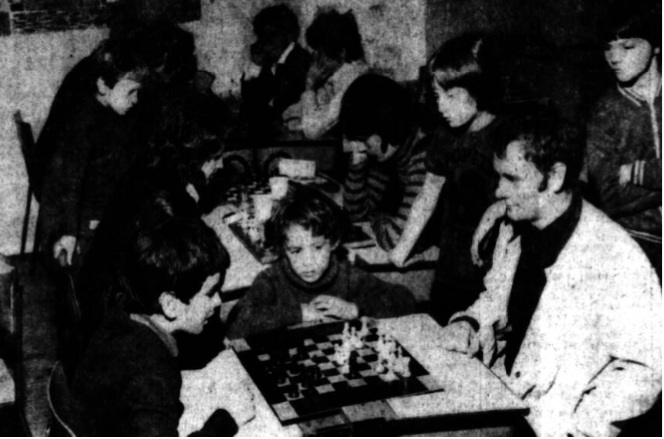
Emyr Wyn Williams, is pictured on the right playing against his 11 year old son, Duncan at the newly formed Tregarth chess club. Dr. Duncan Williams is today one of the veterans at Morriston chess club, Swansea.
The most experienced players at the club was Bryant P. Bourne (1927-2015) who won the first Welsh Championship. He was originally from Folkestone, Kent. Whilst at the university in Aberystwyth he joined the local town club. In 1953 he married a local lass. Through his work he moved to Ammanford and won the West Wales league with Neath chess club.
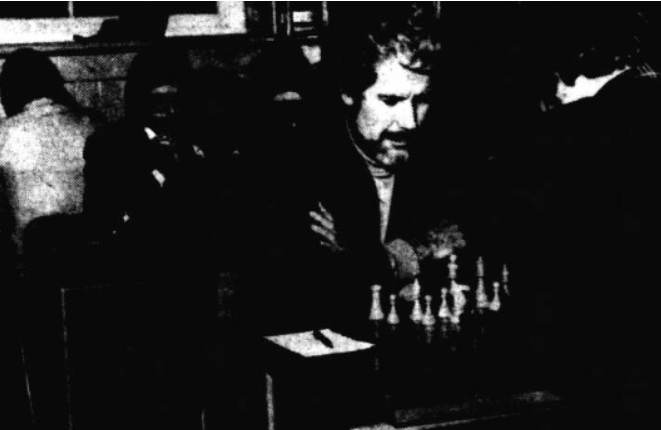
Former Welsh champion, Briant Bourne, in play for Tregarth
against D. M. Thompson of Bernard Wardle. November 1972
The Tregarth team which faced the Bernard Wardle side in 1973 would have formed the basis for its success over the coming years. Emyr Wyn Williams was top board, followed by Briant Bourne, Duncan Williams, Miss D. J. Williams, D. Owen and A. Owen. Bernard Wardle did not enter a team in the second league year, but into the fray stepped Bangor, Bangor University and RAF Valley.
ANGELSEY CLUBS
A club known as Ynys Mon (playing out of Llangefni) won the league title in 1981, breaking the strangle-hold that Tregarth had on the championships. Richard Coupe was their lead player. He was the Principal Educational Psychologist with Anglesey County Council.
Richard was Gwynedd individual champion six times between 1976 and 1985. This was to be the only success for any of the Anglesey chess clubs.
There are no newspaper or Welsh chess magazine records before 1985 which could have provided details, but there is mention of Biwmaris (Beaumaris) taking part in the league 1985-2000. This club played at the Beaumaris Community Centre and was run by Gareth Oliver. A club at Holyhead 1988-2001 met at the bottom of Holburn Road. The Holyhead club is currently experiencing a third re-launch.
In December 1977 a challenge was issued by the Shetland Isles to all other islands around Britain. They had played Anglesey on 7th November in a telephone match and tied 3.5-3.5. The challenge was taken up, but there are no official records of these matches or even of who the winners were. All matches were played by telephone.
In 1978 Lloyds Bank stepped in as sponsors and the final of the ensuing competition was played in June 1979 between Anglesey and the Isle of Wight. Other teams that had taken part in the knock-out tournament were Jersey, Guernsey, the Isle of Man and the Shetlands. Llew Evans was a keen supporter of the competition and he captained the Anglesey side. They played the final from the Milk Marketing Board creamery in Llangefni. Briant Bourne commented: “It’s not really that expensive. The telephone bill will come to about nine pounds, which is cheaper than travelling to Rhyl to have a game.” After a six hour struggle the Welsh team lost 4 ½ – 2 ½. This is the only record of Anglesey reaching the final.
The following year Anglesey beat Shetlands in spite of a 17-move loss on top board. Each team consisted of a woman, an Under 18, an Under 15 and four other players.
1984 saw the same two islands meet with Anglesey having the Irish international John Moles on top board. The lady representative for the Shetlands also controlled the telephone whilst playing – an impossible situation.
The competition petered out in the mid-1980s when the two finalists could not agree on arrangements to play each other.
BANGOR
There are only two clubs that have continued to compete in the league through recent decades, Bangor and Caernarfon. Bangor won the Gwynedd League in 1991, 1993, 1996, 2017, 2019, 2025 and 2026. In recent years they have been fortunate to find an able administrator – essential to the well-being of every club – in Catriona Coutts. Their strongest player for many years was John Shakespeare but today Chris Wescomb with a live grade of 1914 (June 2026), plays on top board.
CAERNARFON
The town won the Gwynedd League in 1989, 1990, 1994, 2003, 2020 and 2023. The winning team in 2020 was from Elijah Everett, Cliff Rice, John Bowers (a former Cardiff player), Deio Parri and Mike Blake with Barrie Wells. In 2023 Elijah Everett played in one match and there were appearances by Mike Leaver (now Porthmadog) and Ciaran Dwyer. They finished ahead of the University, Bangor and Colwyn Bay clubs.
The club has an unusual meeting pattern. They meet every Thursday at 2 p.m. in the library and twice a month on Thursday at 6.30 p.m. With a small number of matches (in comparison with other leagues) to cater for, it is possible to be much more flexible.
Modern clubs, to be successful need to tap into the surge in interest shown by younger players and also to embrace the library support for chess which has seen new groups set up throughout the country. Caernarfon seem to have done that and their upward trajectory washighlighted over the St. David’s weekend in 2026 when they put on a 5-round chess tournament. It was won by Chris Wescomb of Bangor. The club also had the important support of the local town council.
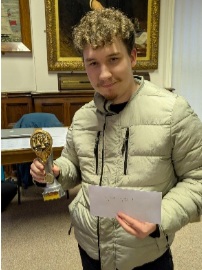
Chris Wescomb of Bangor
OTHER CLUBS
BETHESDA
There was a short-lived club at Bethesda between 1987 and 1989.
LLANBERIS
There was a club at Llanberis between 1985 and 2001 organised by Robin Kirkwood and Hugh Banner, a well-known rock-climber. Kirkwood went on to play for Caernarfon, Bangor and Llandudno. The club met at the Padarn Lake Hotel. Home-grown product, John Tombs became the club’s leading player. He won the Gwynedd individual title 1994, 1995, 1997 and 1998. Llanberis’ only league victory came in 1988. The club survived at least until 2001.
PORTHMADOG
This club was started in 2024. It is another library-based club with former league secretary John Bowers and author, Mike Leaver at the helm.
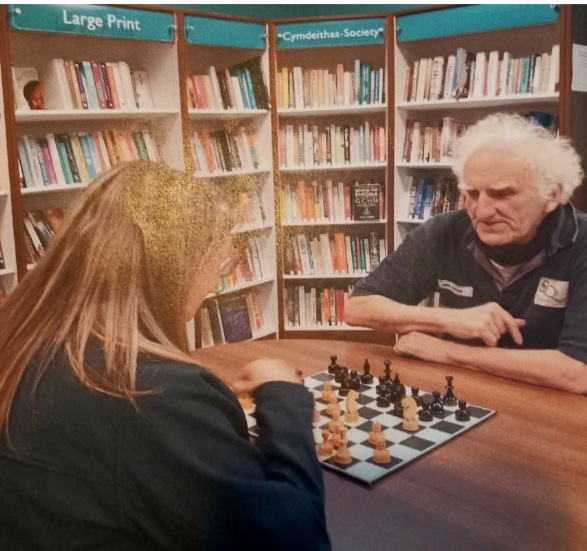
Mike Leaver at Porthmadog Library
BARMOUTH
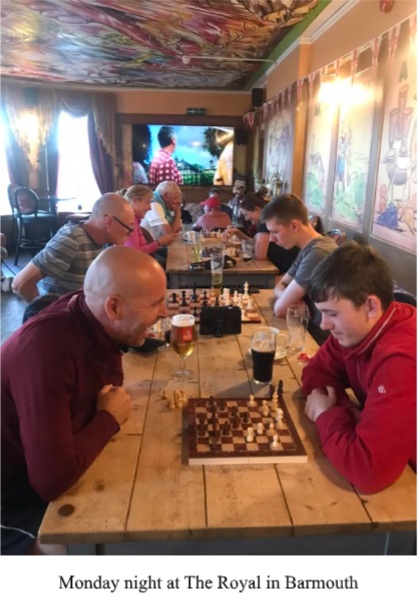
Yet another club set up in 2024, purely on a social footing.
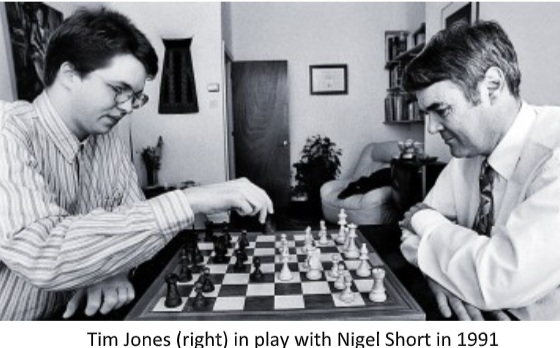
There may not be any famous chess players who come from Barmouth, but how many would have swapped places with Tim Jones who, as a journalist, covered the epic struggle between Bobby Fischer and Boris Spassky in Iceland? Tim Jones (1943-2015) was the son of a electrician and shop owner in Barmouth. One report said, ‘When trying to get an interview with the American contender he was told, “Shove off jerk!” Nevertheless, he did later get a signed program from Fischer which remained a treasured possession.’ He played chess for Bourne End in Berkshire.
BANGOR UNIVERSITY
The university unexpecedly won the Gwynedd Lerague in 2018. It was very closely fought. At the end of the season there ws a three-way tie between the University, Bangor and Caernarfon, the result being decided by looking at the results between those three teams.
One of (or perhaps the main) driving force for the club was Catrina Coutts who is now the mainstay of Bangor chess club. Every club needs an able adminsitrator without whom nothing gets done and university students are, for some reason, more prone to being disorganised than any other group. They obviously have the talent but need someone to put it all together. It is sad that just a few years later the students no longer represent their university in the league.
The team which won the league was Hai Tran, Filip Molnar, Catriona Coutts and Robert Hurst. The university students have, over the years, met regularly at their own chess club but have more often than not, chosen not to compete in the league. This is probably partly due to their proximity to the Bangor city club and indeed, the latter presently meets on the campus. It is also noticeable than a lot of the league individual champions came from the university but played for clubs elsewhere in the league.
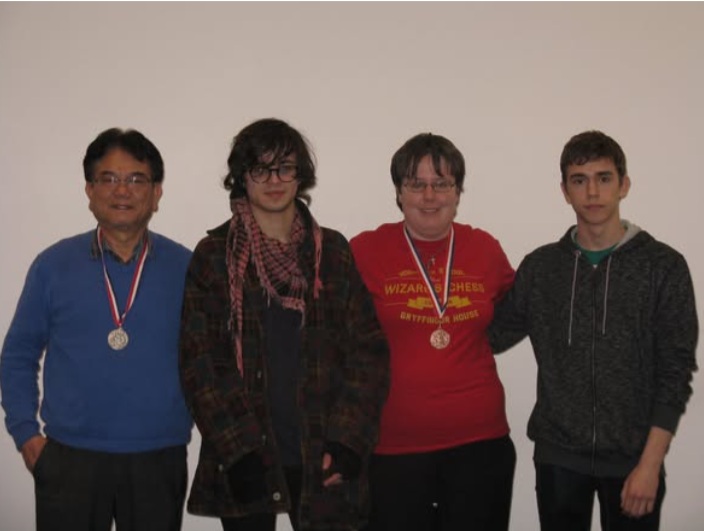
The 2019 Bangor University team at the British Universities’ Championships.
Hai Tran (left) won a silver medal on Board 1, scoring 8/10. Catriona Coutts (in red) had a bronze medal on
Board 2 scoring 6.5/10. Also pictured are Igor Pantea and Duarte Bota.
_________________________________________________________________________________
From the highs of the 1970s the league in the 2020s was more or less obliged to invite
Colwyn Bay, Rhyl & Prestatyn to take part or to be left unviable with just two clubs. The future perhaps lies with the new clubs currently struggling to establish themselves. Holyhead in Anglesey and Barmouth and Porthmadog on the west coast are the fledgling clubs that will hopefully grow and help expand the league in the near future.
GWYNEDD INDIVIDUAL CHAMPIONS

LEAGUE CHAMPIONSHIP
The team winners of the Gwynedd League are missing the results 1996 and 1998-2016 (records lost).
The results were placed on a floppy disc which has since been lost.
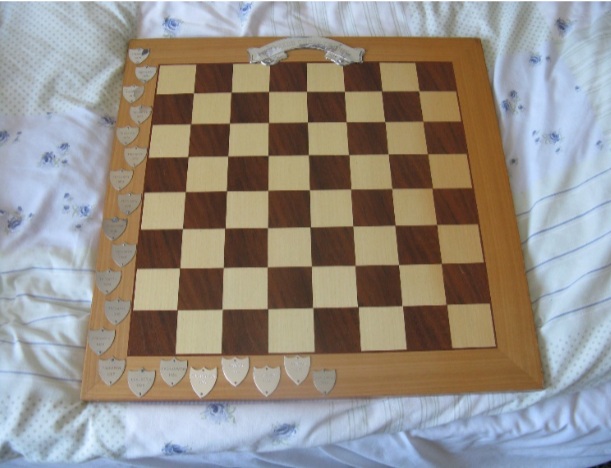
The League Championship trophy which was lost for many years,
hence the missing shields
SOURCES
North Wales Chess by David Castledine….1988
The Cheshire Hundred by Richard Furness…1988
MAGAZINE OF THE UNIVERSITY COLLEGE OF NORTH WALES…NLW
Newspaper archives.
Many of these Club Histories are incomplete and this one in particular has
some huge gaps in the narrative. This is largely due to the fact that the minute
books and records have either been lost or destroyed over the years. If anyone should re-discover these records or any part of them, then I feel sure that the
website manager will be only too pleased to update the record.